
Foot & Ankle Fracture Reconstruction
You didn’t come this far to stopFoot and ankle fracture reconstruction refers to surgical procedures used to realign and stabilize bones that have been severely broken or displaced. The primary goal is to restore the natural structure and function of the foot or ankle to prevent long-term complications like chronic pain or arthritis.
Common Reconstructive Procedures
Surgeons choose specific techniques based on the severity and location of the fracture:
Open Reduction and Internal Fixation (ORIF): The most common surgery for displaced fractures. The surgeon makes an incision to manually realign bone fragments (open reduction) and secures them using hardware like metal plates, screws, or rods (internal fixation).
External Fixation: Used for severe or complex breaks where the skin is damaged. Metal pins or screws are inserted into the bone above and below the fracture and attached to a stabilizing frame outside the body.
Joint Fusion (Arthrodesis): If a fracture has caused severe damage to joint cartilage, the bones may be fused together with plates and screws to eliminate painful movement.
Soft Tissue Repair: Complex reconstructions often involve repairing torn ligaments (like the syndesmosis between the tibia and fibula) or damaged tendons to ensure joint stability.
Bone Grafting: If bone is missing or severely crushed (impacted), a bone graft may be used to provide a "scaffold" for new bone growth.
Reasons for Reconstruction
While minor fractures may heal with a cast, reconstruction is typically required when:
Bone Displacement: Fragments are no longer aligned, which can lead to improper healing (malunion) and arthritis.
Joint Instability: The injury has compromised the structural integrity of the ankle mortise or foot arch.
Open Fractures: The bone has broken through the skin, requiring immediate surgical cleaning and stabilization.
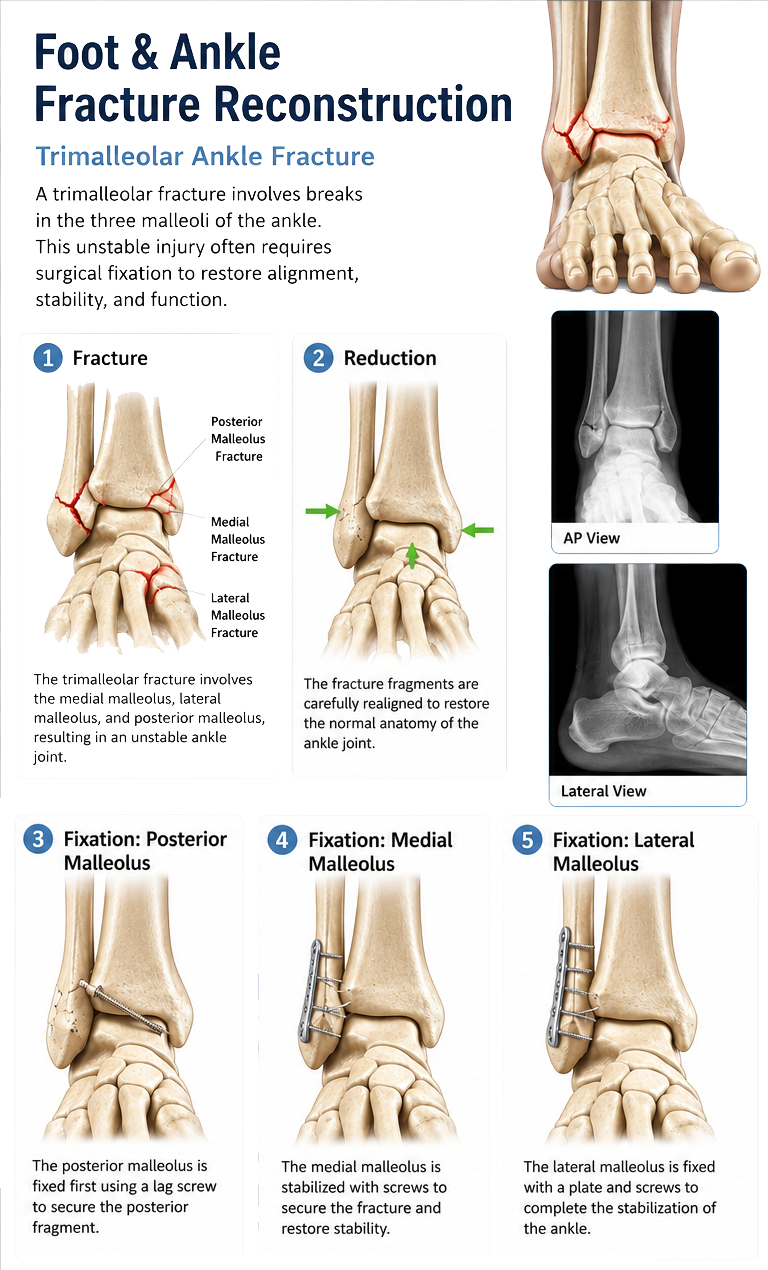
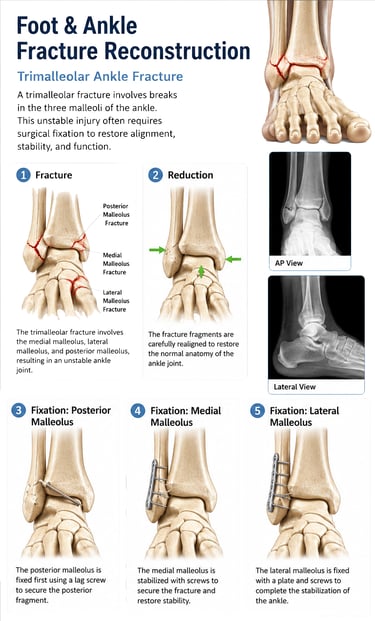
Multiple Breaks: Complex injuries like bimalleolar or trimalleolar fractures involving multiple bones usually need surgical intervention.
Recovery and Rehabilitation
Recovery from reconstructive surgery is a long-term process that varies by injury complexity:
Immediate Post-Op: You will likely be in a splint, cast, or boot and must remain non-weight-bearing for 2 to 8 weeks.
Transition to Walking: Once cleared by a physician, you may begin gradual weight-bearing in a walking boot, eventually transitioning to normal shoes with a brace.
Physical therapy is essential for restoring strength, balance, and range of motion. Full recovery generally takes 6 to 12 months
Contact
Reach out for expert foot and ankle care
Call Us
248-471-3312
© 2026. All rights reserved.